| Specifications |
 |
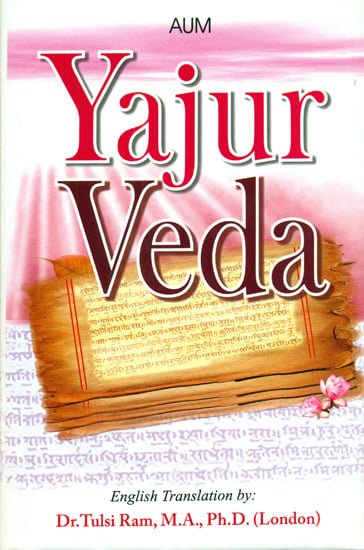
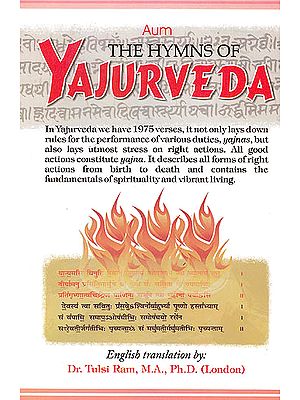
Publisher: Arsh Sahitya Prachar Trust |
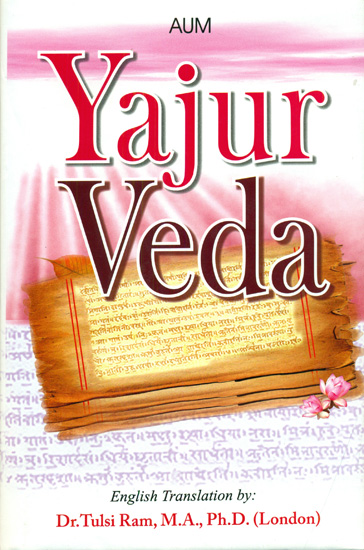
| Author: Dr. Tulsi Ram | |
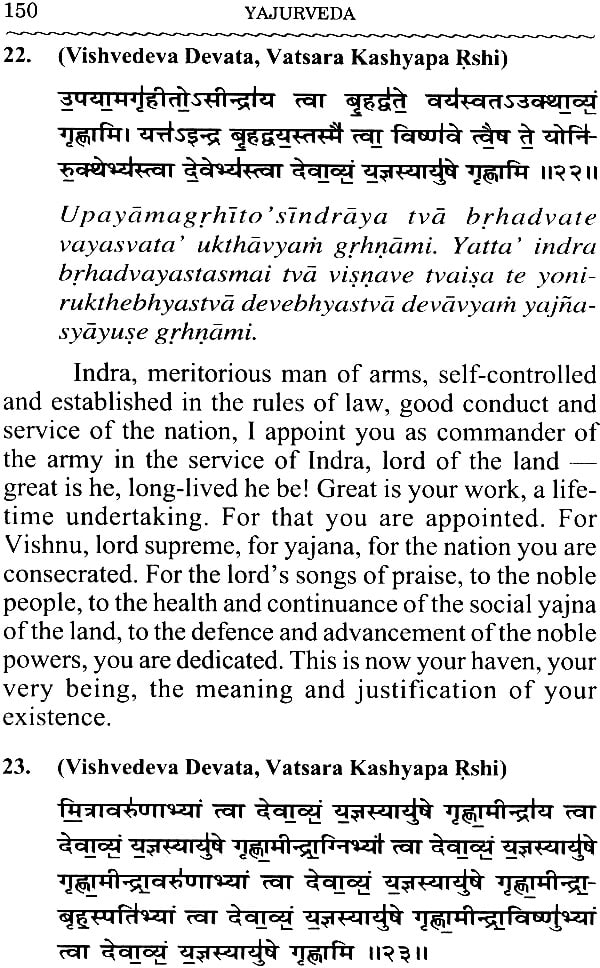
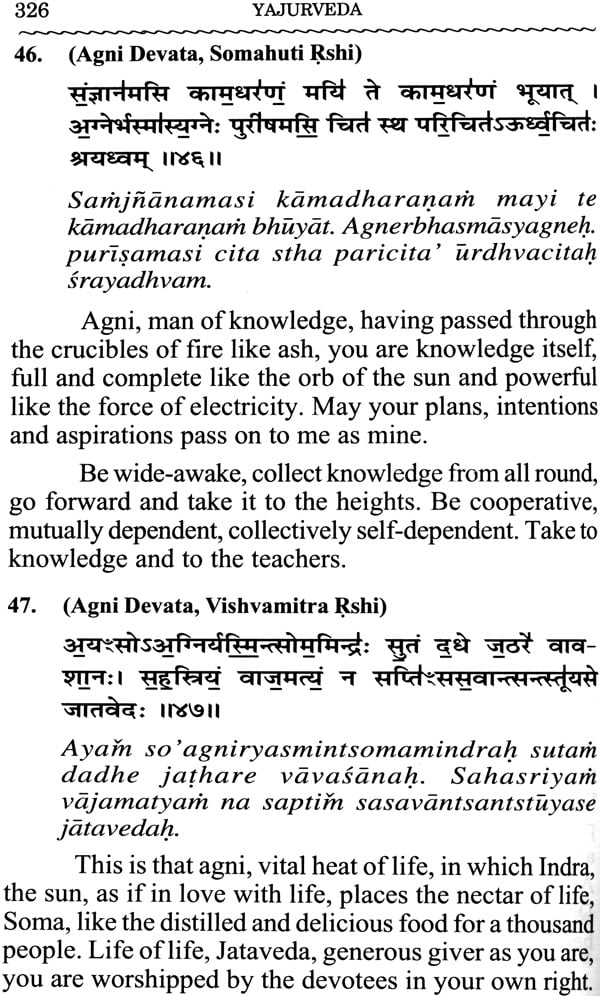
| Language: Sanskrit Text with Transliteration and English Translation | |
| Pages: 1096 | |
| Cover: Hardcover | |
 |
8.5 inch x 6.0 inch |
 |
Weight 1.30 kg |
| Edition: 2013 | |
| ISBN: 9788183858786 | |
 |
NAK543 |
| Delivery and Return Policies |
 |
|
 |
Returns and Exchanges accepted within 7 days |
 |
Free Delivery |


About the Book
'Veda' means knowledge, pure knowledge in scientific
style, no story, no history, no mythology.
The four Vedas are Divine Knowledge of existence in
the essence: the first, original and complete universal knowledge of Nature,
humanity and Divinity revealed at the dawn of creation for the enlightenment
and guidance of humanity on earth. As first Revelation, they are Shruti, the rest is Smrti,
Reminder, search or research for the essence of various branches of existence.
Of the four, Rgveda is Jnanaveda, Yajurveda is Karmaveda
for human guidance in action, Samaveda is Bhaktiveda
for divine celebration, and Atharvaveda is Brahmaveda,
tribute to Brahma, Sukshatra for all.
Yajurveda is knowledge of the science of living,
being as well as becoming, at the individual as well as the collective level in
relation to Nature, humanity and Divinity. There is nothing unrelated, nothing
isolated in the world. The universe is Purusha, a
living, breathing, intelligent, self- organising, sovereign system, the sole
ruler and ordainer of which is the Omniscient,
Omnipresent and Omnipotent Cosmic Spirit, Brahma Supreme. We all are cells in
the cosmic body of this Purusha, living and
participating in the organismic System of the world
for the fulfilment of personal as well as Divine
purpose.
Life is a gift of Savita,
Lord Creator and Giver of light, food and energy for body, mind and soul. We
thank the Lord, and the Lord enjoins us to the highest action, yajna, positive, creative and collective activity in a
state of good health, freedom and prosperity.
Yajurveda celebrates the glory of active life: the
preparation for living, love and marriage for the joy of family life,
retirement, community life of Varna-Ashram Dharma, national and international
organisation, Rashtra and Swaraj,
Parliamentary Democracy, duties of the people and the rulers, this on the
social side. Then knowledge of body, mind and soul, birth and rebirth, journey
of the soul across birth and death, self-realisation through comprehensive
living in organismic relationship with Nature,
humanity and the Lord Supreme. In short, life is a four-act play in the eternal
drama of existence in which we have countless exits and entrances, without
beginning and without end. The wonder is that the exit and entrance are
simultaneous, identical like the Zero and 2400 hours of the day-night cycle.
The vibrancy of life is capped with the warning of
death, which too is a gateway to life again or to the ultimate freedom of
Moksha in the presence of OM Kham Brahma.
About the
Author
Dr. Tulsi
Ram Sharma M.A., English (Delhi, 1949), Ph.D. (London, 1963) has been a university professor,
academic administrator, researcher, and writer of long standing with
prestigious assignments.
Besides his professional studies of secular
literature in English, Hindi, Sanskrit and Urdu, Dr. Tulsi
Ram Sharma has devoted his life and time to the study and discipline of Sacred
literature specially Vedas, Upanishads, Darshan
Philosophy, Puranas, Ramayana, Mahabharata with concentration on the Bhagwad Gita, Greek, Roman, Sumerian and English Epics, Gathas of Zarathustra, Bible, Quran, and the writings of
Swami Dayananda, and Swami Vivekananda, in search of
the essential values of Sanatan Vedic Dharma with
reference to their realisation in life and literature through social attitudes,
collective action, customs, traditions, rituals and religious variations across
the fluctuations of history.
Foreword
Veda Bhashya by Prof. Tulsiram
- A step to make Vedas available to the English World
I have had the privilege of going through some of
the chapters of Yajurveda Bhashya written by Prof. Tulsiram,
a well known Vedic scholar and author of English language and literature. I
congratulate him because he has done this translation for an average English
reader who is keen to know the Vedas. Knowledge of the Vedas is like the
knowledge of science. Vedic language is a scientific language and nobody can
understand that without the profound knowledge of Vedangas,
especially Nirukta of Maharshi Yaska
and the grammar of Panini and Patanjali. Nobody can interpret the Veda mantras
without these two. This translation proves that Prof. Tulsiram
has done this insightful translation after doing hard work in both Vedangas.
In translating the Vedas, only literal meaning is
just not sufficient, sometimes it may create confusion and contradiction. Prof.
Tulsiram deeply merges himself into Vedic Mantras,
thinking deeply about words, derivatives and analyzes the hidden nuances of
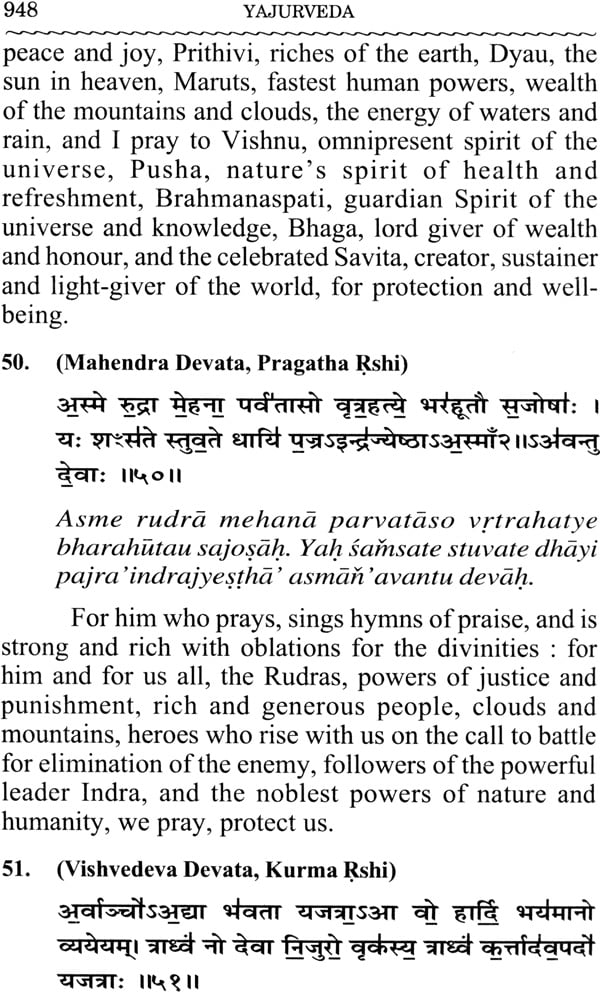
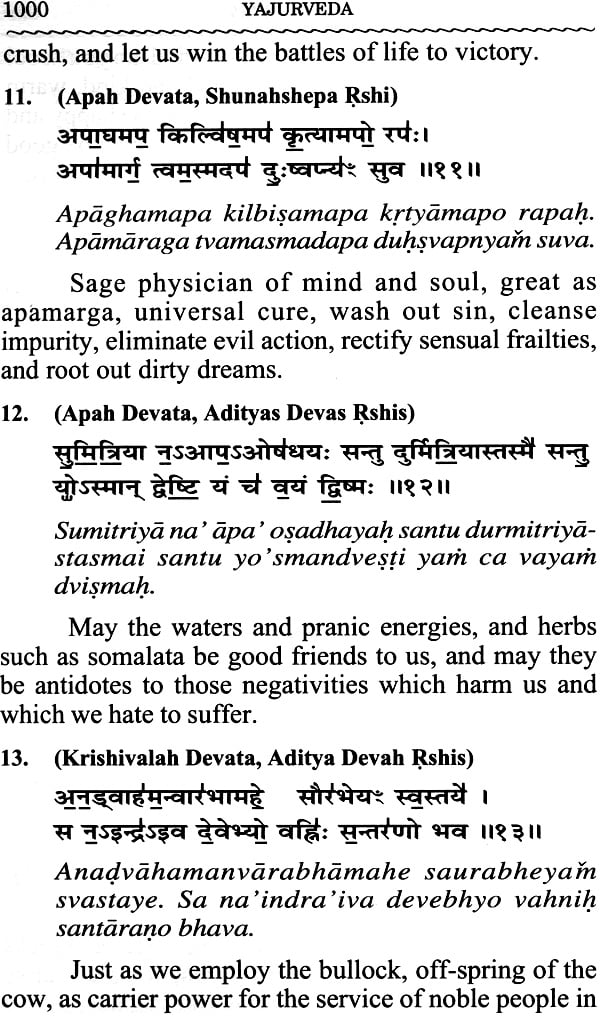
meaning in their context. For example, 'Sumitriya na aapa oshadhayah
santu .
Yajur.
36, 23': If we take literal meaning in the ordinary sense, "may the
waters, vital forces of life, and herbs be friendly to us and may they be
enemies to those who hate us and whom we hate", it will not make
acceptable sense. After raising some questions, he says, "How can we
accept this?" So, after going deeply into the words and context he gives
this meaning of the said mantra: May
waters, tonics, pranic energies and medicinal herbs
be good friends of our health system and immunity and let the same waters,
tonics, pranic energies herbal medicines act against
those ailments, diseases and negativities which injure us, which we hate to suffer and which we love
to destroy, moreover let them have no side effects because side effects too
help the negativities and injure us.
After giving the actual sense of the Mantra he writes
that this Mantra is a reasonable prayer for the health programme of an advanced
society, and then, logically in the next Mantra, follows the prayer for a full
hundred years and more of life and healthy living (Tacchakshurdevahitam
purastat-Yajur.36,24).
The translation by Prof. Tulsiram
is without any extraneous motive and without any extra-academic intention. The
translation has been done purely as communication of the Vedic message for the
welfare of mankind.
While giving his opinion on the Vedas Prof. Tulsiram writes in his Introduction. Veda is the Voice of
God revealed in scientific Vedic Sanskrit free from local color and historical
facts, therefore Vedic language is to be interpreted and understood according
to its own laws and structure, and the only key available for such
interpretation is the Nirukta of Maharshi Yaska and the grammar of Panini & Patanjali. According to
Maharshi Dayananda Saraswati, 'without reference to
these bases of Vedic interpretation certain words have been given a distorted
meaning in the translations of Max Muller, Griffith, Whitney and even Sayana.'
Actually the torch light for proper translation today, as Aurobindo says, is
the Arsha tradition followed by Maharshi Dayananda Saraswati.
At the end I will say that this translation of
Yajurveda, based on Nirukta and Grammar, follows the
known ancient Indian tradition. It is factual, without prejudice or hidden
motive. Prof. Tulsiram thinks deeply on every word of
the mantra, looks into the context and etymology according to Nirukta and then does the translation. I congratulate him
on this one more pioneering step to make the knowledge of Vedas available to
the western world and the average English knowing reader. May God give him long
and healthy life so that he continues to do this kind of stupendous work.
Introduction
This translation of Yajurveda is meant for an
average English knowing reader who is keen to know:
What is Veda? What is it all about? Is it old or
new?
If it's old, what is its relevance today? And if it
is relevant, is it relevant to me also? Or is it relevant only to some
particular community in some particular country at some particular time?
These are relevant questions especially in an age of
science, democracy and globalism.
Veda is Divine Knowledge in metalanguage.
The very word 'Veda' means knowledge. It is derived from the root 'vid', which means: 'to be, to know, to think, to benefit
from' and 'to communicate' .
So whatever is is Veda: the
very world of existence is Veda. The knowledge of the world of existence is
Veda. The extension of knowledge through thought and research further is Veda.
And to use that knowledge for the benefit of mankind with the protection and
preservation of nature and the environment, without hurting any form of life,
that is Veda.
Veda is knowledge, pure and simple, as science is
knowledge. Science is knowledge of nature as nature is and as it works
according to its own laws. In science, there is no story, no history. Similarly
in the Veda, there is no story, no history. And just as science is knowledge in
scientific language free from local colour and historical variations of form
and meaning, so Veda too is knowledge in scientific language free from local colour
and historical variations. Therefore Vedic language has to be interpreted and
understood according to the laws and technique of its own structure as stated
by seers such as Yaska, Panini and Patanjali and as
explained by Swami Dayananda in his grammatical works
and his notes on Vedic words in his commentary on the Vedas.
But there is a difference between scientific
knowledge and Vedic knowledge: While science is knowledge of nature to the
extent that man has been able to discover it, Veda is the quintessential
knowledge of all that is, including Nature and humanity, all that happens, all
that we are, all that we do, and all that we reap in consequence of our action.
It is the Original and Universal knowledge of the Reality of Existence and the Ideality of our aspirations, covering the facts and
processes of existence, their interaction and the laws that operate in the
interaction. In short, Veda is an eternal articulation of Omniscience, The
Voice of God.
Vedic knowledge is classified thematically into three:
Stuti, Prarthana and Upasana. Stuti, praise, is solemn
reverential remembrance and description of the attributes, nature, character
and function of divine powers. Prarthana, prayer, is
an autosuggestive resolution to realise our
limitations and rise above those limitations by calling on Divinity for aid and
blessings when we have exhausted our effort and potential. Upasana
is meditation, the surrender of our limited identity to open out and
participate in the Divine Presence. Stuti implies
knowledge (Janana), Prarthana
implies humility and action (Karma), and Upasana
implies total love and surrender (Bhakti). In consequence, formally, Vedic
knowledge is divided into four:
Rgveda is the Veda of Knowledge,
Yajurveda is the Veda of Karma, Samaveda is the Veda of Bhakti, and Atharva-veda is Brahma Veda, an umbrella, celebrating the
Divine Presence as in Book 10, hymns 7 and 8.
Yajurveda is Karma Veda, knowledge of the
application of knowledge in practical living in a positive, creative and
constructive manner at both the individual and the collective level This way of
living and working is "Yajna" which, in
simple words, means a selfless and participative way of living and thereby
creating the maximum out of the minimum for all, including nature, humanity,
the environment and the whole universe, with complete faith in the living,
breathing, organismic, intelligent, self-organising,
self-conscious, Sovereign System. Living the yajnic
way, we realise that Nature is an organism, a tree, Ashwattha,
and the entire cosmos including ourselves is a Purusha,
and we as human beings are but cells in this Divine Purusha.
Without living this way in a state of full awareness, we cannot realise that
you and I, Mother Nature and the Supreme Brahma are all together, one in union
and communion.
Vedic knowledge then is the Divine knowledge of life
in existence from the dimensionless point and particle unto Infinity. And
prayerful living and communion in meditation and yoga means: Self-integration
of the particle, Re-integration of the part with the whole, and Re-union of the
finite with the Infinite.
This is the climactic close of Yajurveda: The light
and life that shines in and beyond the sun is that Supreme Purusha.
That is there, and that is here in me.
Om is the saviour. Om is Brahma. Brahma is Infinite,
Sublime!
The message of Yajurveda begins with the rousing
divine call to live: "Be vibrant as the winds!" But we must be
gratefully vibrant: "O Lord we pray for and thank thee for the gift of
food and energy for life, for the health and efficiency of body, mind and
soul." All of us must dedicate ourselves to Savita,
giver of life and light, with devotion to the highest, yajnic
action, we must not hurt the cosmic 'Cow', and we must not allow a thief to
boss over us and deprive us of our freedom of thought, word and deed.
As you open the text of Yajurveda, you find the
words: Savita Devata, Prajapati
Parameshthi Rshi. 'Devata'
here means the subject which is dealt with in the mantra. 'Devata' as a Vedic
term means a presence, a power, a force, which is brilliant, illuminative, and
generous. The 'Devata' of a mantra may be God, the One Sacchidananda
Brahma as in the closing mantra quoted above, or Savita,
the same One self-refulgent God as in the opening mantra; or it can be a
generous divine power of Nature such as the sun, moon, earth; or it can be a
noble person of brilliant quality of nature, character and performance as a
ruler, leader, commander, teacher, etc. What the 'Devata' means in any
particular mantra depends on the total context that emerges from the mantra.
Prajapati Parameshthi
is the Rshi of the opening mantra. The Rshi in the Arsh tradition is not
the author of the mantra, Rshi is the exponent of the
meaning of the mantra. As Maharshi Yaska says in the Nirukta, Rishis are the 'seers of the
mantras': they are the sages who went into deep meditation unto the universal
frequency of the Cosmic Mind and experienced the voice of Divinity speaking in
the mantra; the mantra, a Semantic correspondence of the Divine Voice; the
Divine Voice, a sound correspondence of Divine Awareness of the Reality of
Existence in the modes of Being and Becoming.
Who then is the poet of the Vedas? The answer is in
Yajurveda 40, 8: That Cosmic Spirit which pervades and rules every moving particle
in the moving universe is "the poet, thinker, all-comprehending, and
self-existent". That is the Lord who creates the world of existence,
ordains the Laws of its dynamics, and reveals the poetry of its beauty and
majesty, the Vedas. "From that Lord of universal yajna
were born the Rks and Samans.
From Him were born the chhandas of Atharva-veda and from Him were born the Yajus"
(Yajurveda 31, 7). The Vedic lore comes in Pura- kalpa, the beginning of the world of humanity (Shvetashvataropanishad, 6, 22) and when its function is
over at the end of the kalpa, one cycle of existence,
it retires into Brahma- loka (Atharva-veda
19, 71, 1).
The Vedas were revealed by the Lord Omniscient to
four primeval Rshis: Rgveda
to Agni, Yajurveda to Vayu, Samaveda to Aditya, and Atharva-veda
to Angira, directly in their spiritual consciousness.
The Sage Brahma received and collected the four from them and passed them on to
other sages.
When were the Vedas revealed? What is their age? How
old are they? As old as the age of humanity on earth.
The Lord who creates humanity leaves them not to nature like animals. He
enlightens them with the knowledge of existence and their place in the world,
with the vision of their journey, and its culmination.
Swami Dayananda works out
the age of the Vedas on the basis of Surya
Siddhanta which in the year 2010 A.D. comes to
1,96,08,53,110 years. If someone does not accept it and insists on historical
proof, we learn the problem but no possibility of solution on scientific and
historical grounds from Max Muller, a world renowned Vedic scholar and exegesist of the West: Max Muller once ventured to
pronounce a purely arbitrary date based on unproven assumptions that around
1200 B.C. was the date of the Rgveda. Later, he himself
warned his students that "Whether the Vedic Hymns were composed in 1000 or
1500 or 2000 B.C., no power on earth could ever fix .... Whatever may be the
date of the Vedic hymns ... they have their own unique place and stand by
themselves". The daring presumptions of western scholars about the date of
the Vedas are exposed by Graham Hancock in his latest researches, in his book: Underworld: The Mysterious Origins of
Civilization (2002). If no history, no Science, no human imagination can
help, better follow the sages, tradition, Surya Siddhanta, and the daily sankalpa of the dedicated Brahmanas,
and lastly follow the internal evidence of the Vedas themselves: Vedas are the
Original, Universal, Eternal articulation of Divinity, by Divinity, for
humanity at the beginning of human creation.
Since Vedas are the oldest recorded knowledge of the
world, no one can guess how much time, even ages, might have passed between the
Vedas and the next work in Sanskrit. If so, there is no other work in Sanskrit
comparable to the Vedas. Consequently the language of any other work would not
provide any clue for the interpretation of Veda mantras. Vedic language then
has to be interpreted on its own, and the only key available for such
independent interpretation is the Nirukta and
Nighantu of Maharshi Yaska,
the grammatical works of Pinini and Patanjali, and
Swami Dayananda' s notes in his commentary on Vedic
verses explaining the structure and meaning of words. Without reference to
these bases of Vedic interpretation, certain words have been given a very
twisted meaning in other translations, by Max Muller, Griffith, Whitney, and
even Sayana. The torch light for proper translation today is the Arsh tradition followed by Swami Dayananda.
The Arsh way is the only
right way, the key, to discover the truth of the Vedas. According to Shri
Aurobindo, Swami Dayananda alone, in modem times,
possessed this key to the secret of the Vedas. Interpreted this way the Vedas
shine in their essential scientific refulgence. As science is pure knowledge,
no story, no history, no mythology, so are the Vedas, pure knowledge: knowledge
of nature, mind, spirit, human society, Dharma, the
dynamics of existence and the right way of living as individuals and as members
of organised society up to the international level. Even Max Muller, though he
was once committed to uprooting the religion of India by his arbitrary
translation of Rigveda, had to admit in his Biographical Essays that: "To Swami Dayanand,
everything contained in the Vedas was not only perfect truth, but he went one
step further and, by their interpretation, succeeded in persuading others that
everything worth knowing, even the most recent inventions of modem science,
were alluded to in the Vedas. Steam Engines, Electricity, Telegraphy and Wireless
Marconogram were shown to have been at least in the
germ known to the poets of the Vedas". In fact Shri Aurobindo in his essay
on "Dayananda and the Veda" goes even
further: "There is nothing fantastic in Dayananda' s idea that Veda
contains truth of science as well as truth of religion (i.e., Dharma). I will
even add my own conviction that Veda contains other truths of a Science the
modern world does not at all possess, and in that case, Dayananda
has rather understated than overstated the depth and range of the Vedic
wisdom". (see Bankim,
Tilak, Dayananda, p. 57).
The basic requirement of scriptural interpretation
for us is faith and intelligential solemnity, not
doubt and cynicism. This way, if we want to confirm our faith in the scientific
vision of the Veda, refer to Rgveda I, 34, 7 and 9
for three-stage rocket chariot of the Ashwins, to
1,36,18 for Agni missile, to 1,37,3 for winds and communication, to 1, 46, 10
for concentration of light, to 1, 52, 1 and 1, 36, 1 for the science of missile
defence and space- craft, to 6, 46, 11 for missiles and war heads, and so on.
Position of the solar system with planets and satellites, earth's and sun's
gravitation, solar healing, parliamentary democracy, organisational structure
of the nation and the international world, water and electric energy, and so
many other subjects are hinted at in Vedic verses. We need serious research to
work out the details. Had even Einstein read the Purusha
Sukta of the Vedas and Brahma Sutras and Sankhya Vaisheshika philosophy, probably he would have found clues
to his Unified Field theory of the universe.
Beyond faith and intelligential solemnity we need
vision, potential Darshan of the Vedic Rshis. Once you have had the vision of truth, doubts
disappear and questions recede into silence because then, nothing shines but
the Truth, and Divinity Itself reveals It's Reality
with showers of Grace. In this mood and in this spirit, I suggest, you start
your search for Vedic Truth and the Mystery of Existence.
Lastly, if the Vedic lore is as old as humanity
itself, what is its relevance today in the modem world? Ask yourself other
questions: What is the relevance of Galileo or Newton or the Theory of
Relativity, two plus two makes four, Swaraj, the
Vedic word for freedom and self-discipline? Truth is truth, when the statement
was made is irrelevant. Vedic truth, if you find it convincing and acceptable,
is relevant not only for today but also for all time, to every person,
everywhere.
Yajurveda itself says (26, 2):
"Yathemam vacham kalyanim avadanijanebhyah":
Just as I speak (reveal) this auspicious holy Word
of the Veda for all people (without any discrimination of high or low), so
should you too communicate it to all people of the world whoever, whatever,
wherever they be.
Contents
|
. |
Particulars |
Page |
|
Homage, Thanks and
Acknowledgements |
VI |
|
|
1 |
About the Author |
IX |
|
2 |
From the Publishers
Desk |
XI |
|
3 |
Foreword |
XII |
|
4 |
About Dr. Tulsi Ram Sharma's English translation of the Yajurveda |
XIV |
|
5 |
English Translation of
Vedic Hymns: An Opinion |
XV |
|
6 |
Message |
XVI |
|
7 |
Message |
XVII |
|
8 |
Appreciation |
XVIII |
|
9 |
Sadbhavana (Good wishes) |
XIX |
|
10 |
To the Reader |
XX |
|
11 |
Introduction |
XXIX |
|
12 |
Diacritical Marks of Transliteration
|
XXXVI |
|
13 |
Yajurveda |
|
|
Chapter-I |
1-18 |
|
|
Chapter-II |
19-39 |
|
|
Chapter-III |
40-65 |
|
|
Chapter-IV |
66-86 |
|
|
Chapter-V |
87-114 |
|
|
Chapter-VI |
115-136 |
|
|
Chapter-VII |
137-169 |
|
|
Chapter-VIII |
170-206 |
|
|
Chapter-IX |
207-236 |
|
|
Chapter-X |
237-260 |
|
|
Chapter-XI |
261-302 |
|
|
Chapter-XII |
303-357 |
|
|
Chapter-XIII |
358-390 |
|
|
Chapter-XIV |
391-416 |
|
|
Chapter-XV |
417-454 |
|
|
Chapter-XVI |
455-486 |
|
|
Chapter-XVII |
487-533 |
|
|
Chapter-XVIII |
534-578 |
|
|
Chapter-XIX |
579-624 |
|
|
Chapter-XX |
625-664 |
|
|
Chapter-XXI |
665-704 |
|
|
Chapter-XXII |
705-725 |
|
|
Chapter-XXIII |
726-754 |
|
|
Chapter-XXIV |
755-773 |
|
|
Chapter-XXV |
774-800 |
|
|
Chapter-XXVI |
801-814 |
|
|
Chapter-XXVII |
815-833 |
|
|
Chapter-XXVIII |
834-863 |
|
|
Chapter-XXIX |
864-893 |
|
|
Chapter-XXX |
894-907 |
|
|
Chapter-XXXI |
908-917 |
|
|
Chapter-XXXII |
918-926 |
|
|
Chapter-XXXIII |
927-968 |
|
|
Chapter-XXXIV |
969-995 |
|
|
Chapter-XXXV |
996-1004 |
|
|
Chapter-XXXVI |
1005-1014 |
|
|
Chapter-XXXVII |
1015-1027 |
|
|
Chapter-XXXVIII |
1028-1042 |
|
|
Chapter-XXXIX |
1043-1050 |
|
|
Chapter-XL |
1051-1060 |




Send as free online greeting card



Visual Search
 Upload an Image