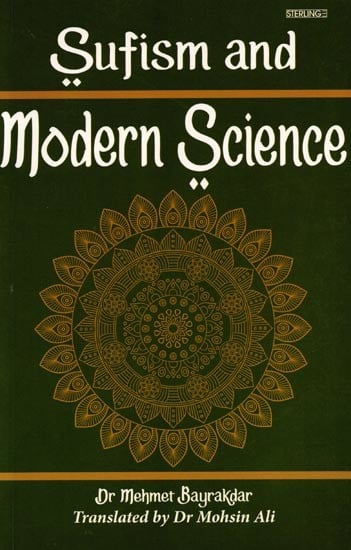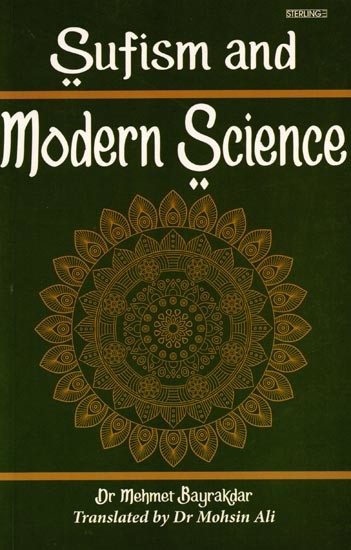
Sufism and Modern Science


| Specifications |
 |
Publisher: Sterling Publishers Pvt. Ltd. |
| Author Mehmet Bayrakdar | |
| Language: English | |
| Pages: 96 | |
| Cover: PAPERBACK | |
 |
8.5x5.5 Inch |
 |
Weight 140 gm |
| Edition: 2021 | |
| ISBN: 9788195082438 | |
 |
HBQ182 |
| Delivery and Return Policies |
 |
Ships in 1-3 days |
 |
Returns and Exchanges accepted within 7 days |
 |
Free Delivery |


Thave been doing research on the Philosophy of Science and I
the History of Science for a long time now. These researches showed me that
many views in Sufism, especially on creation, the universe and the physical and
spiritual structures of humans, are very close to and parallel with today's
data of modern science and the modern theories. Here, in this grand book called
Sufism and Modern Science, I want to show the closeness between Sufism and
science in a short but concise and understandable language. I hope it can be
useful. Effort is from us; guidance is from Allah.
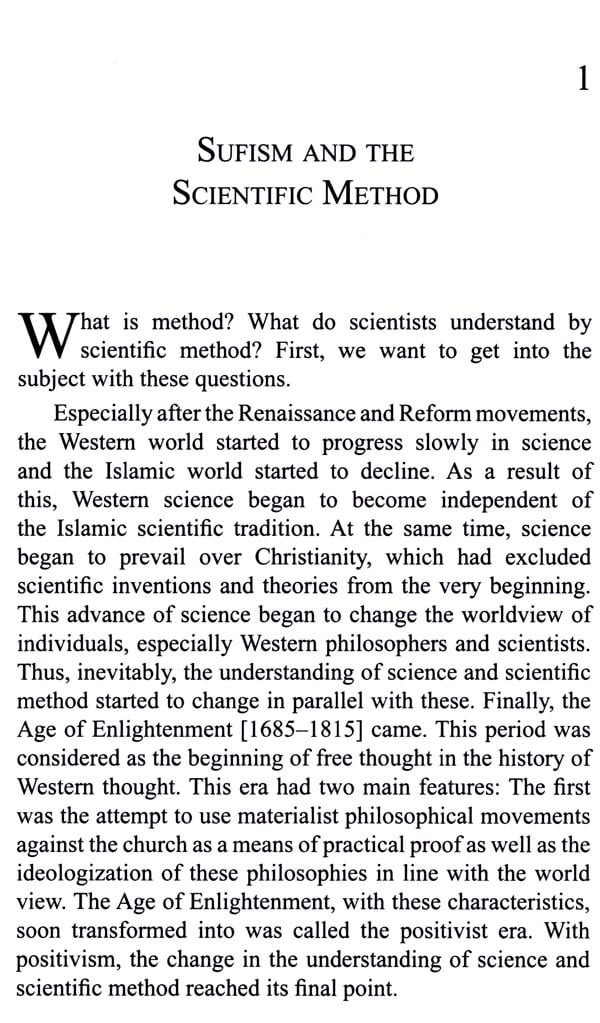
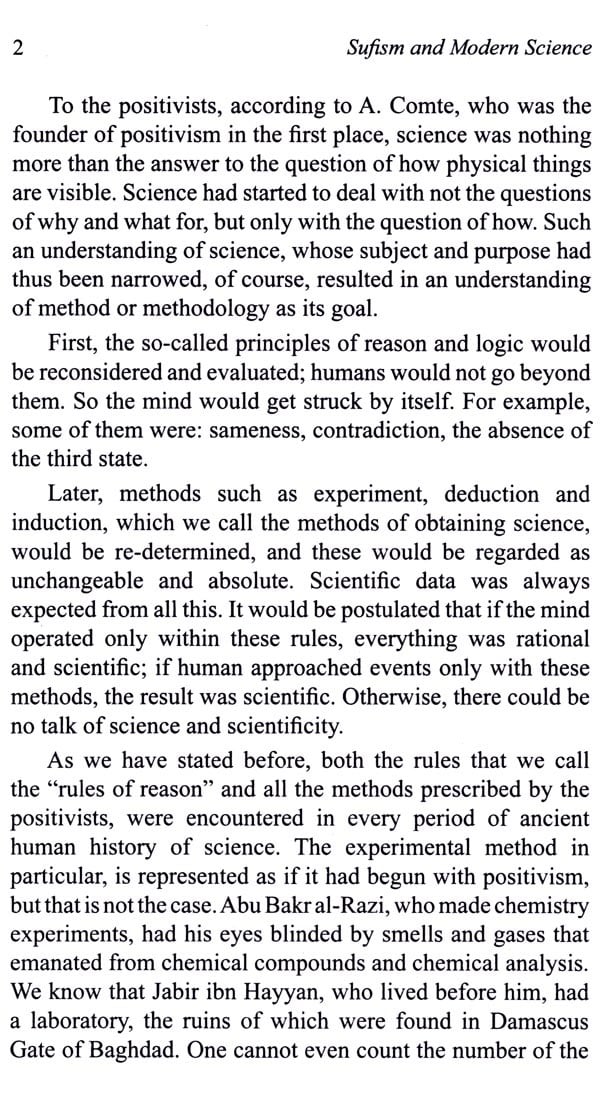
The term modern science is used to express the science of
our age. Of course, this implies that the science of our age is different from
the sciences of ancient times. This difference is explained as the difference
in subject, method and the understanding of science. However, there are
differences of opinion on this issue between philosophers and historians of
science. With the advent of the inept positivists in the 19th century who did
not know about the rich human history, a fashion called "modernity"
entered the picture. Of course, with the amount of knowledge flowing from
history, there are some new things emerging in our age that did not exist
earlier, but this does not mean that the old is worthless or primitive. What
will be the name of our era in the 40th century? Each era will have its own
innovations compared to the earlier ones, and this is quite natural. Could we
rename the theory that we still use in geometry, known as "Pythagoras
Theorem", as Chinese theory since it was recorded in the primitive
language around 1000 BCE, roughly 650 years before Pythagoras? Could we call
the knowledge of astronomy that Babylonians, who lived in 2000 BCE, and could
precisely calculate and determine the solar and lunar eclipses beforehand, as
primitive? Isn't there something ideological in the 19th century Westerners'
representation of the ancients as primitive? To put it more clearly, is s not a
false, ideological trick or delusion that some 19th century and later period
cultural historians have put forward certain theories to glorify the West,
where scientific research have increased in number with time, and to establish
the creativity of the Western mind and therefore the superiority and domination
of the Western race, as if it were a miracle, without having a past?
Many Western science and cultural historians, along with
many other thinkers, testify that the belief of a number of their colleagues
that the birth of modern science happened with positivism is something that is
delusional and unreal. For example, while Ritchie Calder, a science historian
and ideologist, states the beginning of so-called modern science with Francis
Bacon (1561-1626). A thinker and a scientist, who both grew up in the early New
Age, that is, the Renaissance, Daniel E. Gershenson and Daniel A. Greenberg,
also assert that modern science started with Anaxagoras (500-428 bce), one of
the ancient Greek thinkers, in their book Anaxagoras and the Birth of
Scientific Method. Especially when it comes to astronomy, there are those in
the West who claim that modern science started with Copernicus (d. 1543). For
example, Thomas S. Kuhn says so in his book The Copernican Revolution. If
modern science is to be given such an arbitrary start, Muslim scientists are
more worthy of it than Westerners. Because, on the one hand, the Westerners,
who were credited for the birth of modern science, themselves say that they
were inspired by the Muslim scientists. And even if they do not say so,
historically there is a lot of evidence to prove it. On the other hand, there
are several Westerners who have called Muslims "modern".
Dr Mohsin All is a faculty at the Department of Persian
Language and Literature, Faculty of Humanities and Languages, Jamia Millia
Islamia, New Delhi, India. He specializes in the Persianate world studies
through literature, cultural and historical perspectives. He obtained PhD in
Persian Language le Literature, Centre for Persian & Central Asian Studies,
Jawaharlal Nehru University, New Delhi and Master's degree in Turkish Language
& Literature from Erciyes University, Kayseri, Republic of Turkey. He has been
been pursuing specialization uninterruptedly in studies of Turkic world through
Turkish language, culture and historical perspectives. He has been associated
with Turkish Language & Literature Programme since the day of its inception
at Jamia Millia Islamia and is presiding over its evolutionary process. He has
been teaching Turkish language at different levels, ranging from the
certificate gree. He has been to the Honours level of Bachelor of Arts degree.
en rendering his services in formulating syllabi and every other course
curriculum concerning Turkish studies programme. Dr Ali has contributed
research papers to more than forty international and national seminars and
conferences in India and abroad. He has translated eight volumes of
Qissehay-e-Khoob Baraye Bachchehay-e-Khoob from Persian language to Urdu
language and many articles in Persian and Turkish languages. He has visited
centres of higher learning and research of Central Asian & West Asian
countries. He has contributed enormously to the pool of existing literature and
ideas through academic interaction and paper presentation.
-
Q. What locations do you deliver to ?A. Exotic India delivers orders to all countries having diplomatic relations with India.
-
Q. Do you offer free shipping ?A. Exotic India offers free shipping on all orders of value of $30 USD or more.
-
Q. Can I return the book?A. All returns must be postmarked within seven (7) days of the delivery date. All returned items must be in new and unused condition, with all original tags and labels attached. To know more please view our return policy
-
Q. Do you offer express shipping ?A. Yes, we do have a chargeable express shipping facility available. You can select express shipping while checking out on the website.
-
Q. I accidentally entered wrong delivery address, can I change the address ?A. Delivery addresses can only be changed only incase the order has not been shipped yet. Incase of an address change, you can reach us at help@exoticindia.com
-
Q. How do I track my order ?A. You can track your orders simply entering your order number through here or through your past orders if you are signed in on the website.
-
Q. How can I cancel an order ?A. An order can only be cancelled if it has not been shipped. To cancel an order, kindly reach out to us through help@exoticindia.com.