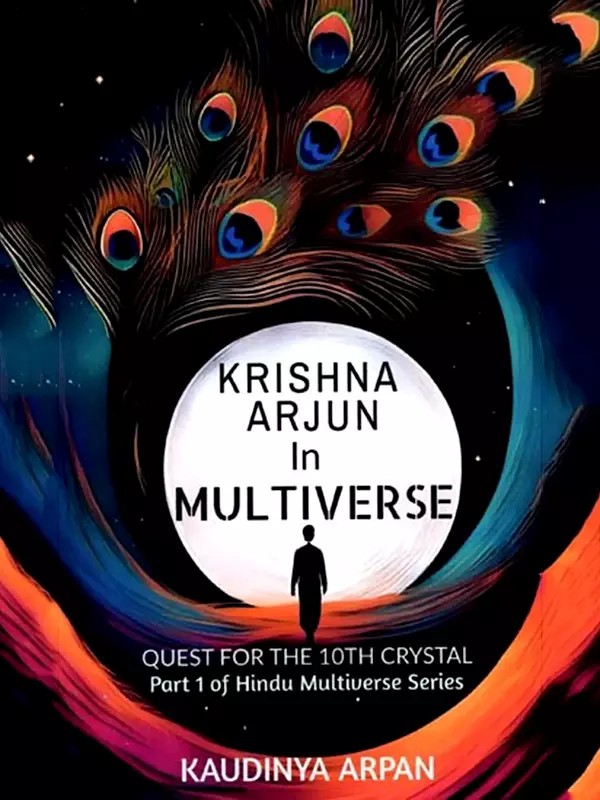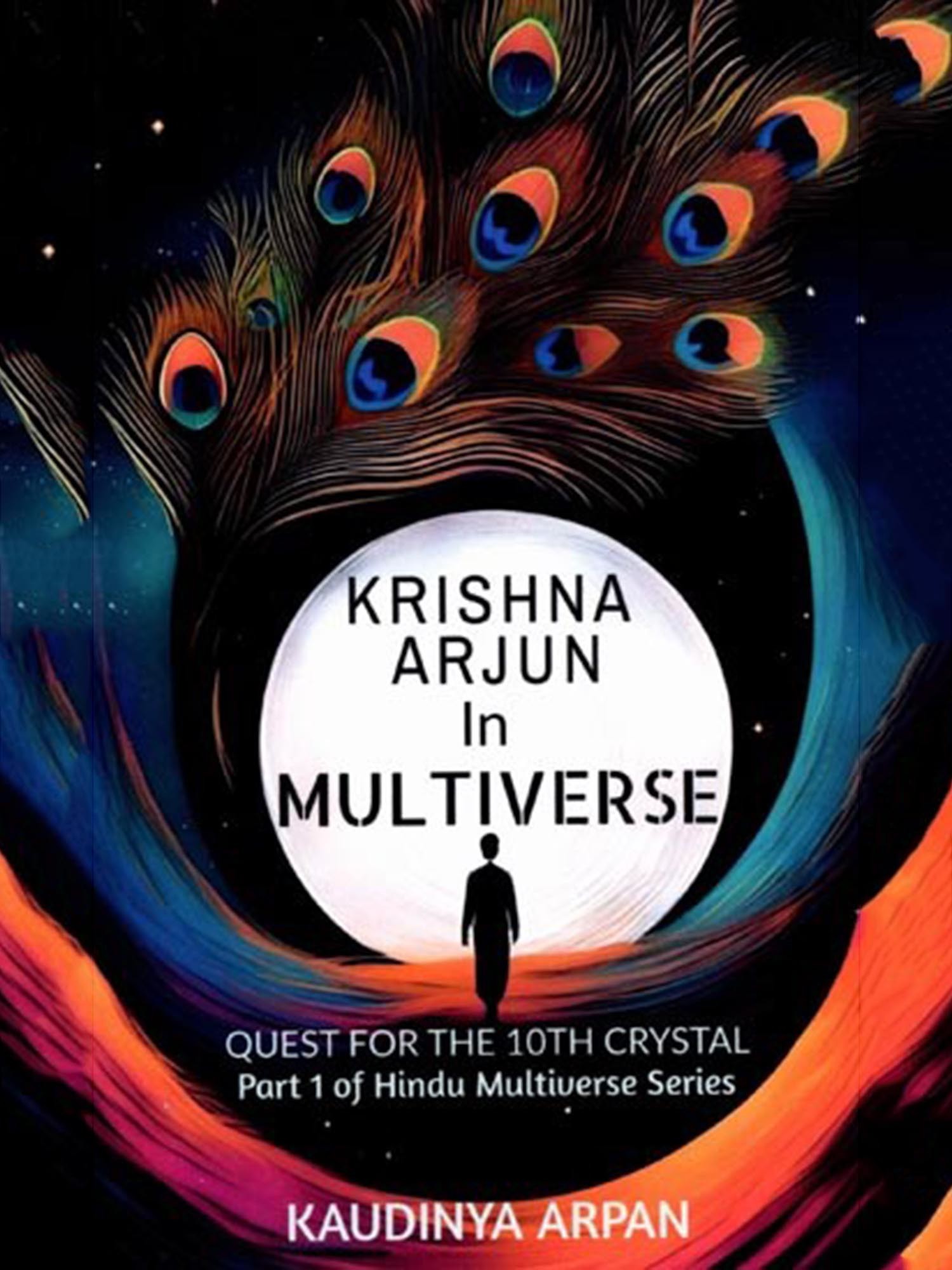
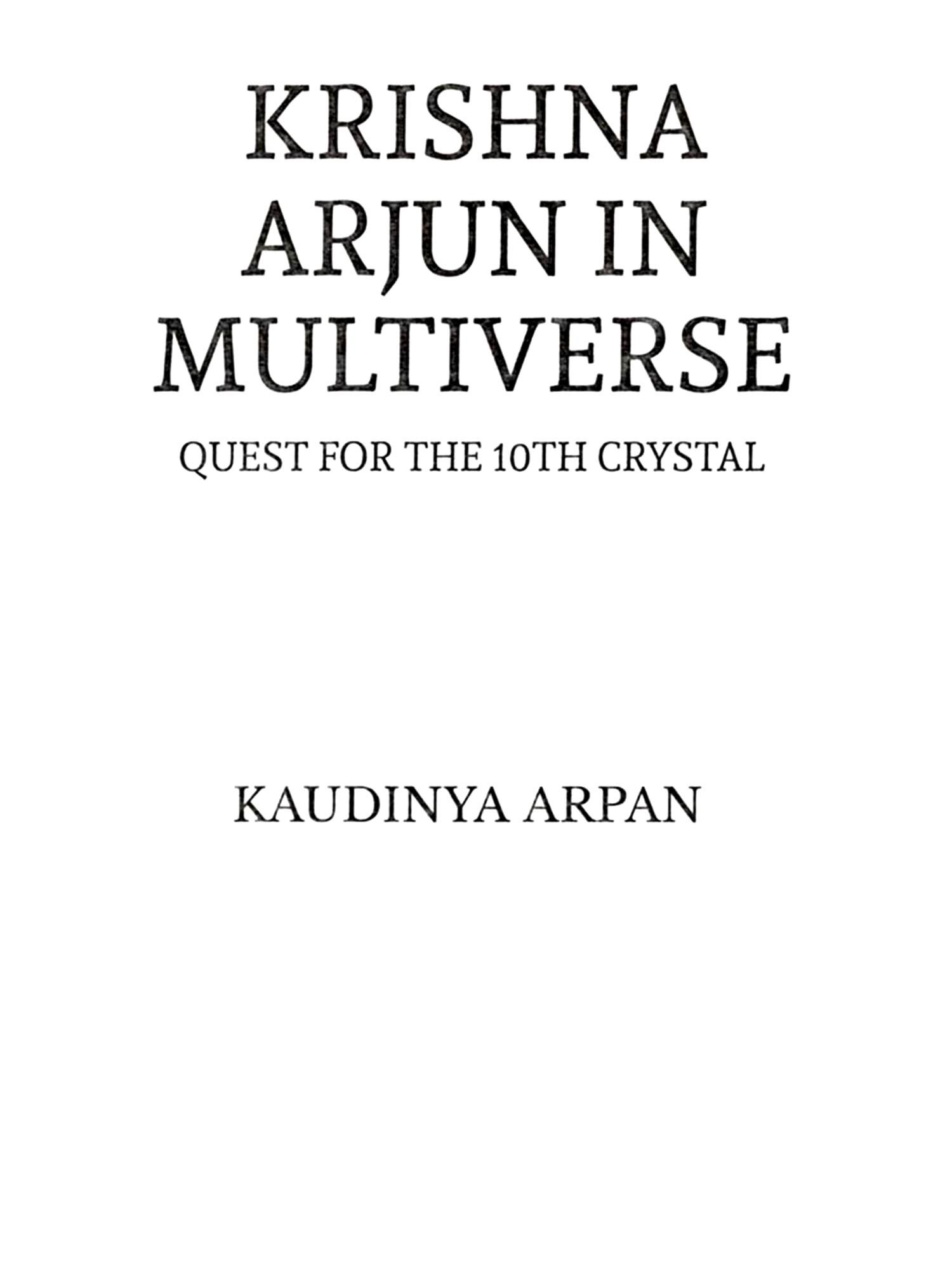
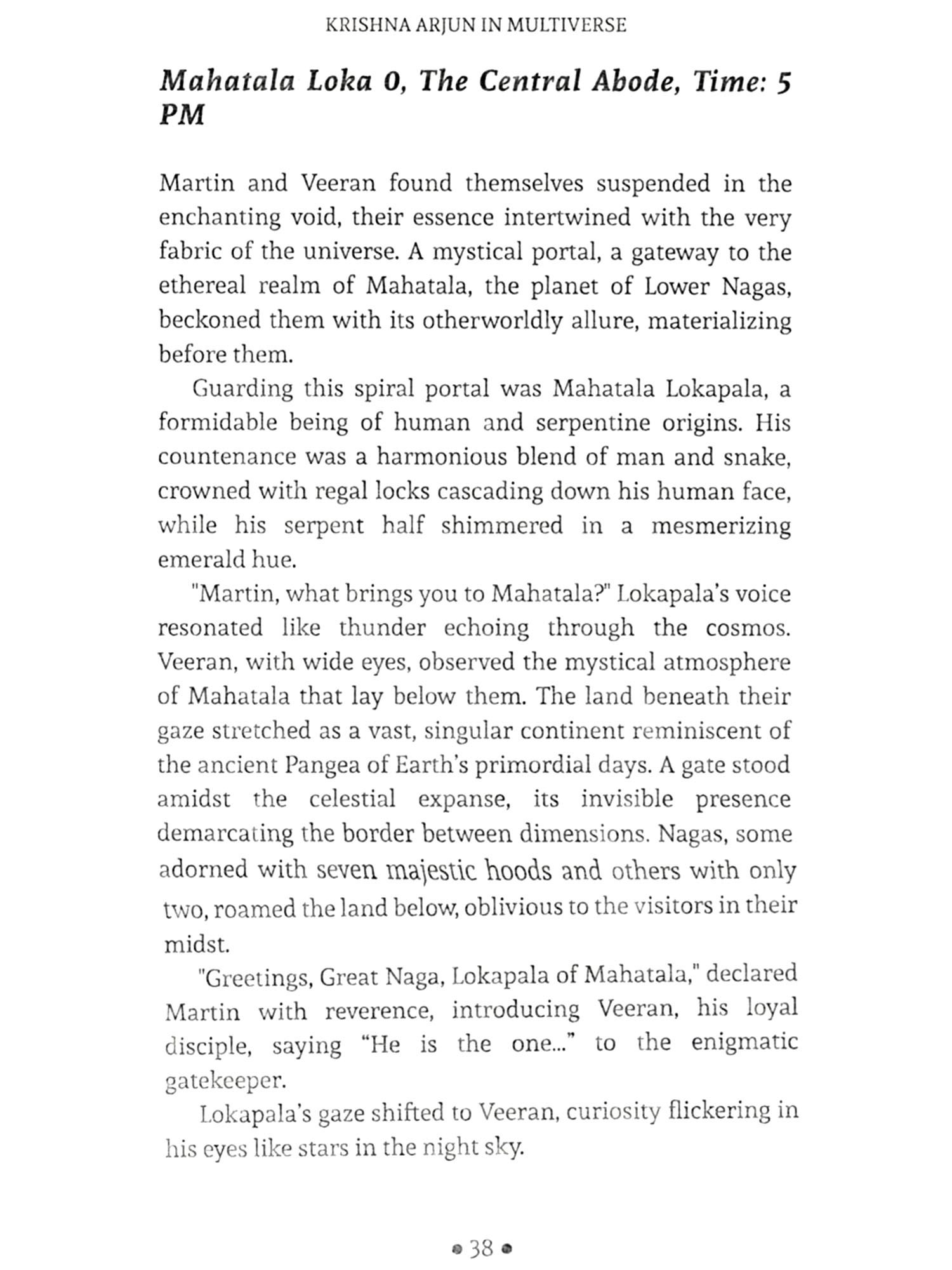
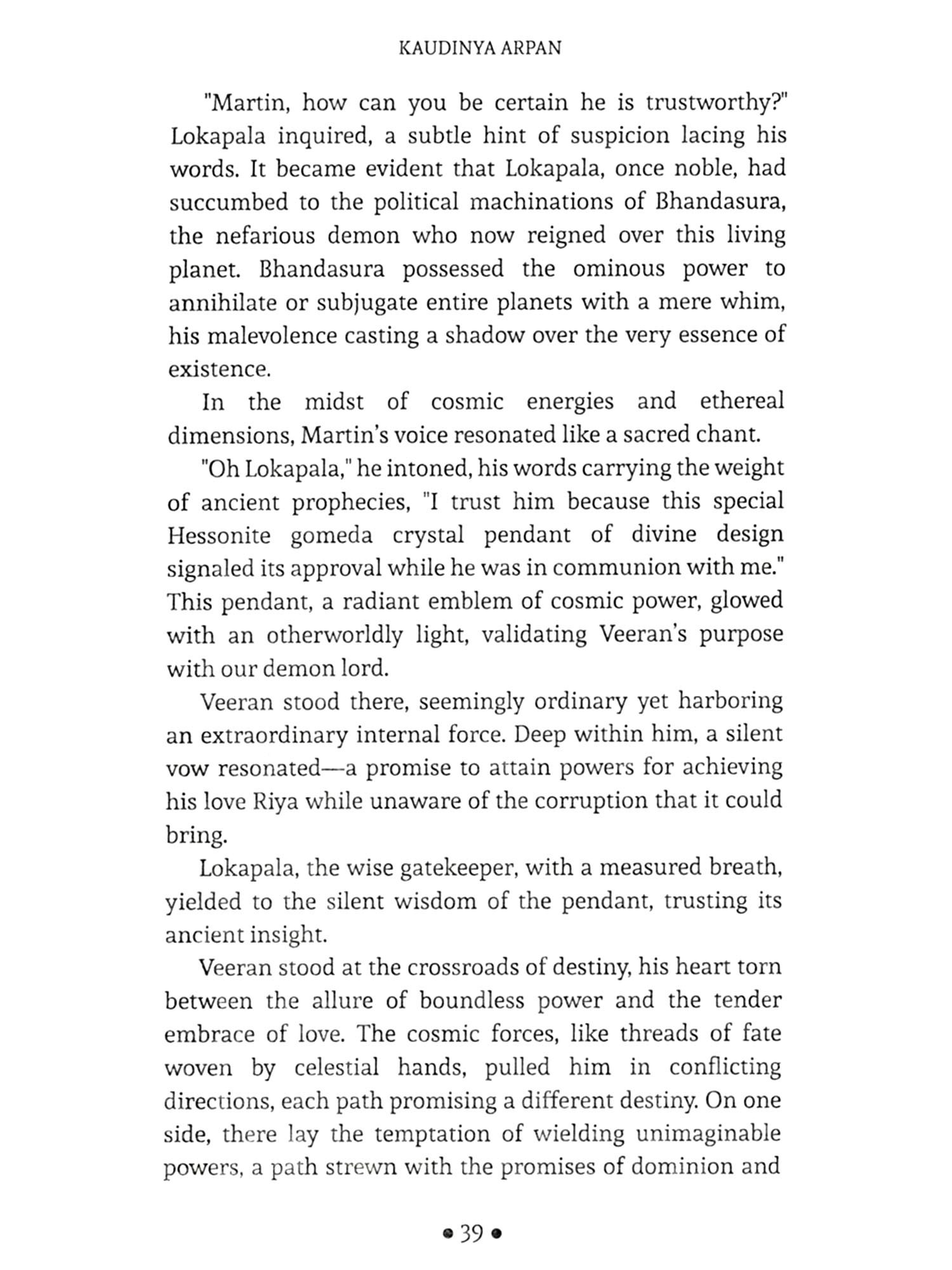
Krishna Arjun in Multiverse: Quest for the 10th Crystal


| Specifications |
 |
Publisher: Notion Press |
| Author Kaudinya Arpan | |
| Language: English | |
| Pages: 293 | |
| Cover: PAPERBACK | |
 |
8.5x5.5 Inch |
 |
Weight 270 gm |
| ISBN: 9798896104988 | |
 |
HBQ189 |
| Delivery and Return Policies |
 |
Ships in 1-3 days |
 |
Returns and Exchanges accepted within 7 days |
 |
Free Delivery |


Part 1 of Hindu Multiverse Series.
Indic belief systems are often misunderstood as mere
elements of "religion." A prime example is the term Dharma,
frequently equated with "religion." In India, when asked about
religious affiliation, most would respond with "Hinduism." However,
Hinduism is far more than a standalone "religion." The term Hindu originates
from the river Sindhu or Indus, and even the name "India" shares this
root. Hindu thus began as a geographical identifier, rather than a purely
religious label. Hinduism represents a complex cultural system that has developed
over centuries within this distinctive cultural setting. While it includes
religious dimensions, this is only a small part of its essence. A similar misconception
surrounds the Vedas, often seen as the "sacred texts" of Hinduism.
Yet, if Hinduism transcends religion, how can it be confined by authoritative
texts? Historically, the knowledge conveyed by sages was termed Vid ("to
know") and organized in the Vedas. Derived from Vid, the Vedas signify a
pursuit of knowledge and encompass the philosophical wisdom of ancient thinkers
expressed in poetry. Not all passages are infallible, yet many carry profound
insights into metaphysics. Before Newton, scientific inquiry in the West was
called "Natural Philosophy." Science emerged as a separate discipline
only when Newton began challenging religious doctrines. Meanwhile, in India,
the Indian Knowledge System (IKS) endured colonial suppression and
fragmentation. Despite this, principles like critical thinking, inquiry, and
reasoning are integral to the IKS. Ancient debates, or shastrarthas, were
intellectual exchanges akin to modern scientific discussions. Yet, as Western
education gained prominence, these were often dismissed as
"religion." Dharma deserves particular attention. Its meaning is
comples, oñen summarized as "Dharayate Ii Dharma that which one upholds as
their duty or role. The Vedas teach that every entity has its own Dharma, the
Earth orbits the Sun in adherence to its Dharma, just as Individuals fulfill
roles as parents, teachers, or students. Dharma is thus not a synonym for
religion. In the Puranas and other texts, we see a range of philosophical
perspectives, reflecting the diversity within Hinduism. For readers interested
in philosophic themes, my book Avatars of Brahma offers a exploration, bridging
Indian and Western knowledge systems. For now, I invite you to begin Krishna
Arjun in the Multiverse, and journey through the Hindu multiverse. Enjoy the
adventure!
In the boundless expanse of the Multiverse lies the
enigmatic realm of "Maha Maya" (spacetime). Here, every choice, every
decision, births a new universe, a mirror of the supreme universe, each imbued
with its unique essence and symphony. Within the Multiverse, each universe
manifests a distinct reality. In some, historical figures forge different
paths, altering the course of nations and civilizations. Subhash Chandra Bose
might rise as India's first Prime Minister, while in others, Sardar Vallabh
Bhai Patel claims that mantle, and in yet others, the concept of a Prime
Minister fades into obscurity. This book draws inspiration from the ancient
Vedic concept of Dyavaprithivi, where everything exists in complementary pairs.
As readers explore its chapters, they may initially draw comparisons to
Heraclitus's idea of the 'unity of opposites,' yet the foundation lies in
Dyavaprithivi itself followed by dualism and non-dualism. I prefer to refer to
this as the 'unity of duality' in a modern context, rather than 'unity of
opposites. As per Dyavaprithivi just as Earth finds its counterpart in Dhyu
Loka, commonly known as heaven, so too does the universe find its pair in the
Multiverse. Hence, each pair of universes bears the distinctive prefixes of 0
and 1, such as 0-18 and 1-18, portraying binary nature of existence. This holds
for every symmetry visible in the universe. With this foundation of
worldbuilding and the backdrop of theoretical concepts like Baryonic asymmetry,
which echoes ancient wisdom, we embark on a journey into the first Hindu
Multiverse and time travel fiction built upon the deepest philosophies of the
world. While not claiming direct parallels between science and the Vedas, this
narrative is presented as the beginning of a novel series, where the realms of
imagination and ancient wisdom converge in possibility and wonder through
science. In Universe 0 and 1, history unfolded under the visionary leadership
of Subhash Chandra Bose, who established the Indic Civilizational Council of
Asia (ICCA) through Azad Hind Fauj (army) and became India's first Prime
Minister. Through the valiant efforts of his Azad Hind Fauj, Bose forged bonds
of solidarity among South Asian nations sharing similar civilizational ethos,
including India, Nepal, Bhutan, Cambodia, and more. Here, geopolitical
boundaries are reshaped. The partition of Pakistan never comes to pass under
Bose's unifying vision. The scars of division are replaced by a shared
motivation, as nations stand united under the banner of cultural affinity and
mutual respect. Moreover, in this universe, Mahatma Gandhi embarks on a
spiritual sojourn to the Himalayas and achieves enlightenment. His story
remains a mystery to the people of Universe 0 and 1. Some say his enlightenment
story is only a conspiracy theory. Universe 0-18 and 1-18 presents a
contrasting reality. Sardar Vallabh Bhai Patel emerges as the inaugural Prime
Minister of India. Patel's vision extends far beyond his nation's borders, as
he orchestrates a symphony of cooperation and friendship among nations. Under
Patel's stewardship, India forges enduring bonds with unlikely allies. Through
adept diplomacy, Patel cultivates a harmonious relationship between India,
China, and the Soviet Union. With strategic alliances and economic prowess,
Asia emerges as a formidable force on the world stage, eclipsing the dominance
of NATO countries and reshaping the geopolitical landscape.
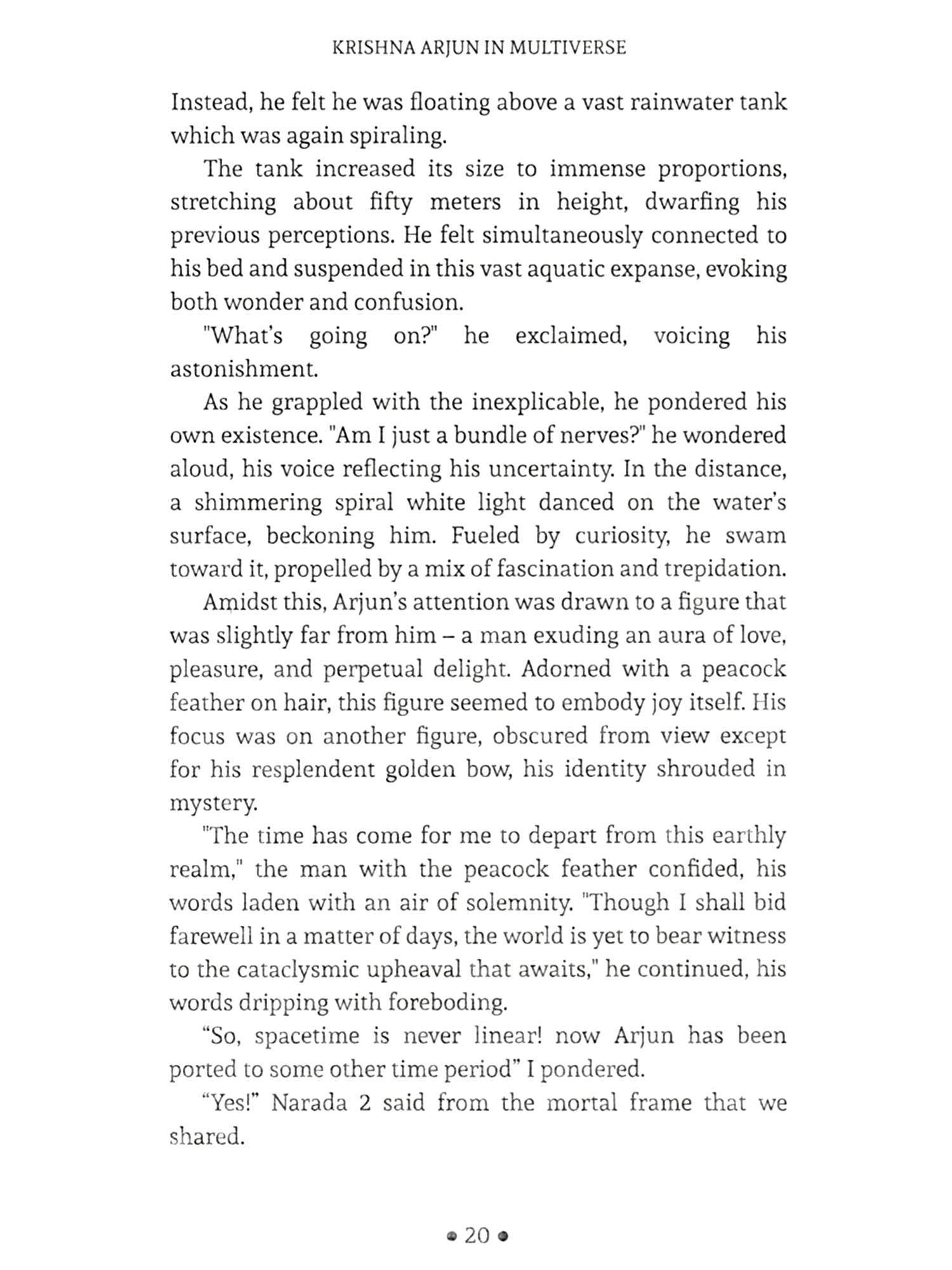
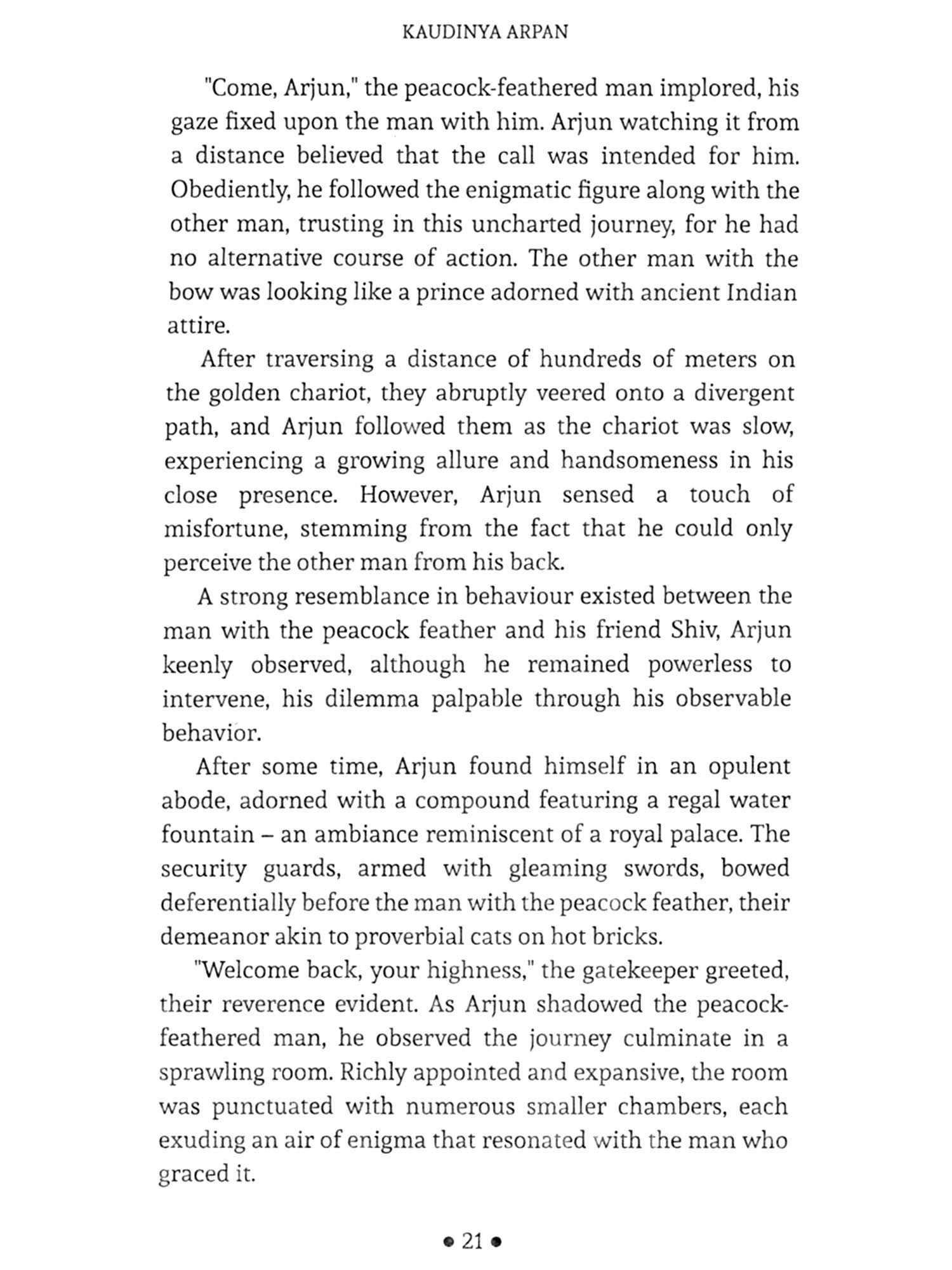
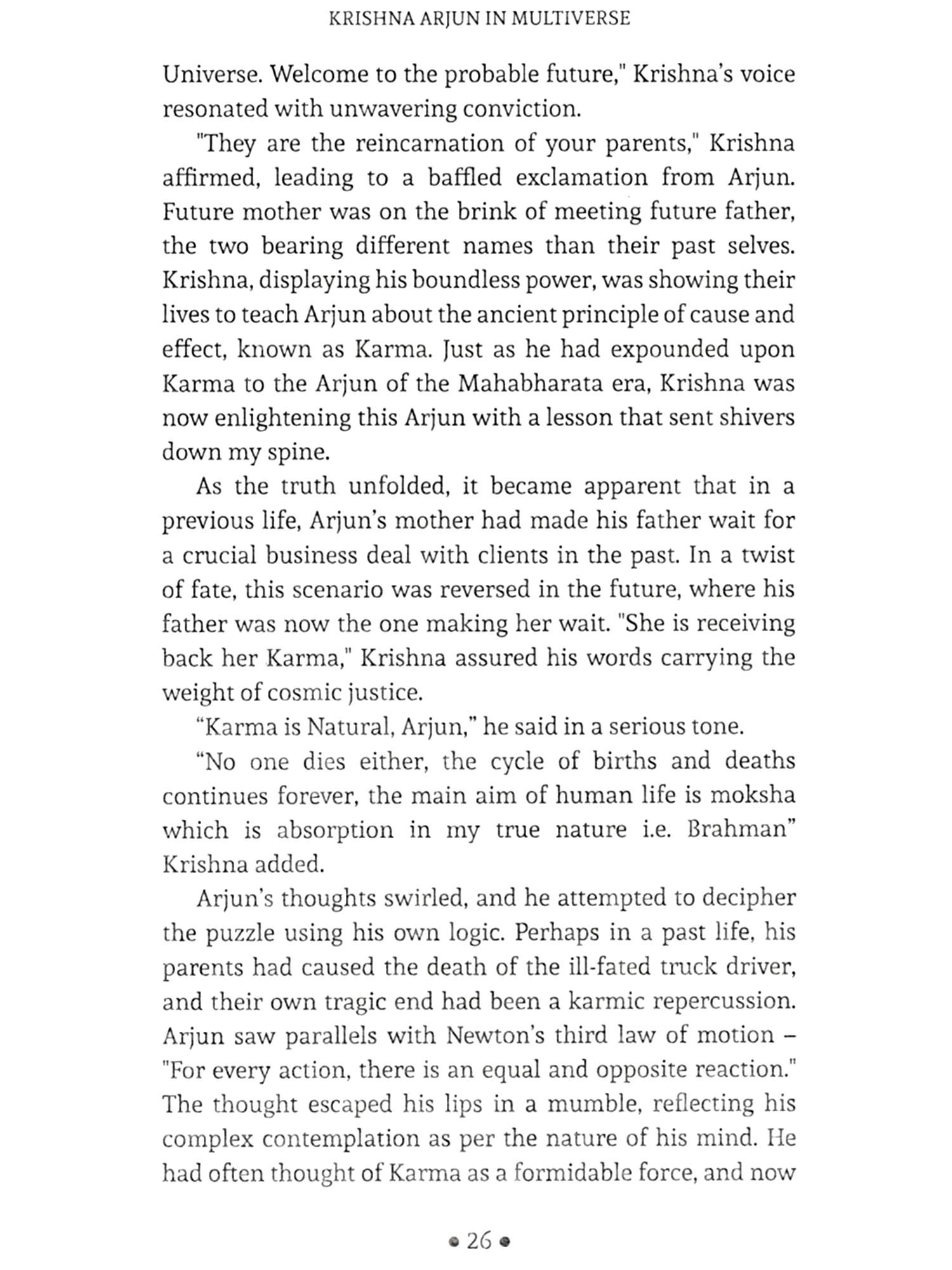
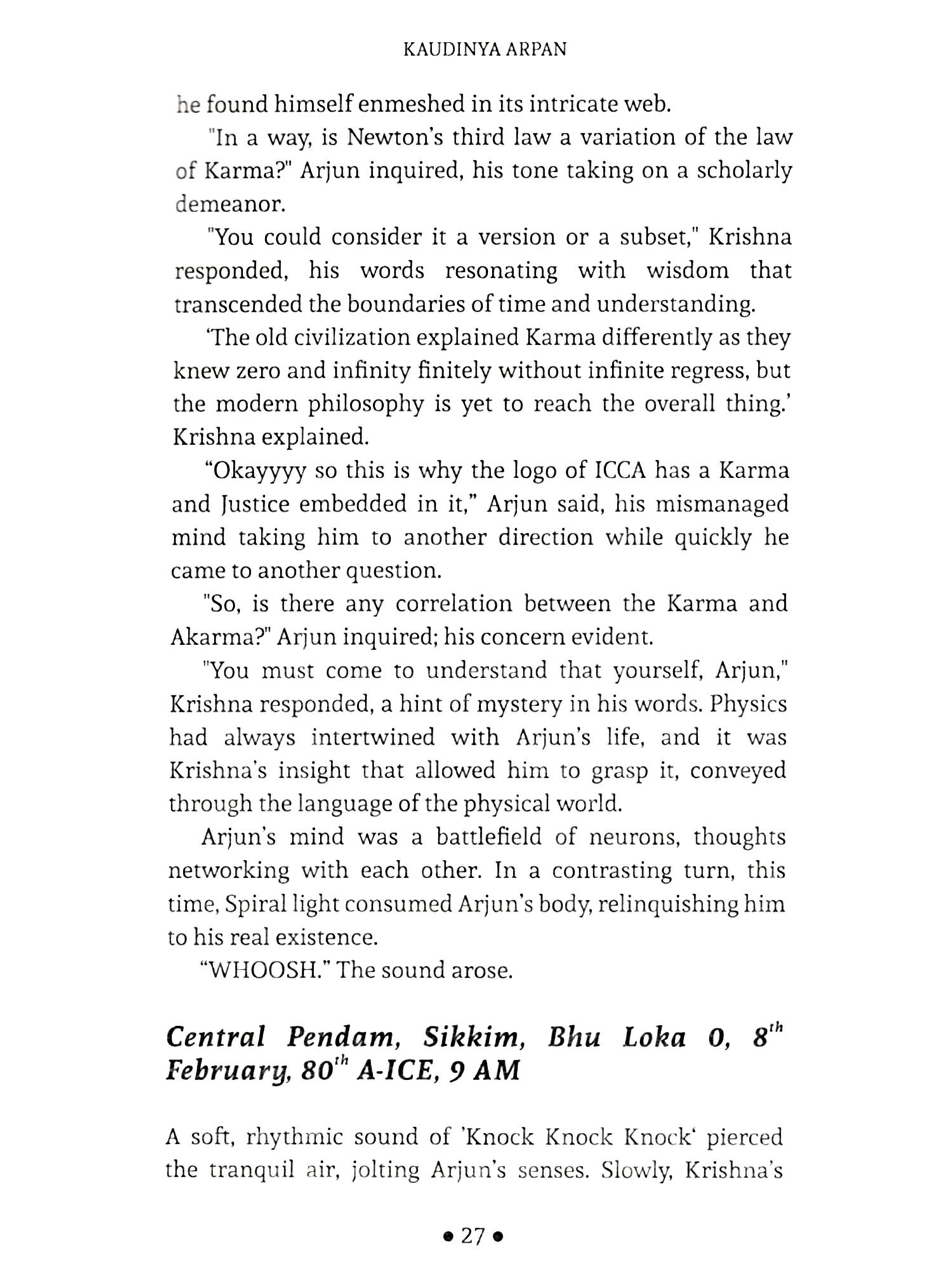
In the multiverse, each universe unfolds its own unique
reality. In some, Subhash Chandra Bose leads India as as its first Prime
Minister, in others, Sardar Vallabhbhai Patel takes the helm. Inspired the
Hindu concept of the multiverse, this story follows Arjun Pandey, an
archaeologist and by undiagnosed ADHD sufferer pursuing his Ph.D. Through a
mysterious cosmic dream, Arjun is transported to a parallel universe
orchestrated by Masto, a supreme spirit of the Himalayas. There, he canny
resemblance to Arjuna of the bears an uncanny Mahabharata. Witnessing the
legendary battle firsthand through spacetime travel, Arjun must find the
elusive tenth crystal to return to his own universe. But an even greater
challenge awaits: defeating Bhandasura, the greatest demon of all time, who
reigns from Mahatala with the support of Queen Himsa from the infernal
Maharaurava. To conquer Bhandasura, Arjun will need the help of the goddess
Tripura Sundari and Kalki, the final avatar of Vishnu. Yet, meeting Tripura
Sundari is no simple feat-she grants an audience only to avatars of Shiva or
during the end times. Can an ordinary man like Arjun, especially one grappling
with ADHD, rise to this cosmic challenge? Find out now!
-
Q. What locations do you deliver to ?A. Exotic India delivers orders to all countries having diplomatic relations with India.
-
Q. Do you offer free shipping ?A. Exotic India offers free shipping on all orders of value of $30 USD or more.
-
Q. Can I return the book?A. All returns must be postmarked within seven (7) days of the delivery date. All returned items must be in new and unused condition, with all original tags and labels attached. To know more please view our return policy
-
Q. Do you offer express shipping ?A. Yes, we do have a chargeable express shipping facility available. You can select express shipping while checking out on the website.
-
Q. I accidentally entered wrong delivery address, can I change the address ?A. Delivery addresses can only be changed only incase the order has not been shipped yet. Incase of an address change, you can reach us at help@exoticindia.com
-
Q. How do I track my order ?A. You can track your orders simply entering your order number through here or through your past orders if you are signed in on the website.
-
Q. How can I cancel an order ?A. An order can only be cancelled if it has not been shipped. To cancel an order, kindly reach out to us through help@exoticindia.com.