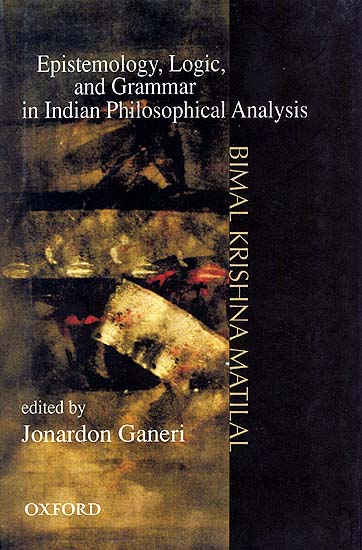

| Specifications |
 |
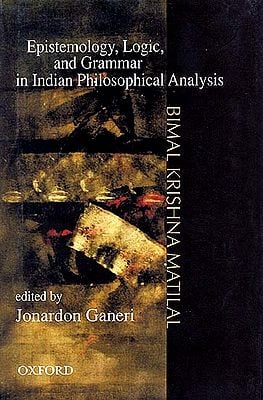
Publisher: Oxford University Press, New Delhi |
| Author: Bimal Krishna Matilal, Ed. By. Jonardon Ganeri | |
| Language: English | |
| Pages: 166 | |
| Cover: Hardcover | |
 |
8.8" X 5.8" |
| Edition: 2005 | |
| ISBN: 0195666585 | |
 |
IDE283 |
| Delivery and Return Policies |
 |
Usually ships in 3 days |
 |
Returns and Exchanges accepted within 7 days |
 |
Free Delivery |


The popular approach to the study of Indian Philosophy was born out of the assumption that critical thinking was unknown to the East. Thus, all philosophical endeavour was thought of fundamentally as a manifestation of religious doctrine, or a form of mysticism. In a climate of growth interest in Indian philosophy, Matilal successfully dispels some of these assumptions, and opens up the rich traditional of Indian philosophical analysis to the modern reader.
This book points to the urgent need for understanding the continuities between analytical and critical traditions of the East and West. Sanskrit has been the language most commonly used in treatises in Indian philosophy. Matilal acknowledges that it is difficult to master it in a way that enables the reader to understand the philosophical content in more familiar terminologies of analytical philosophy in the West. Locating his analysis in the central debate of whether reality is actually knowable and therefore expressible in language, Matilal brings texts hitherto thought of as esoteric, to open up as absolutely central, canonical statements of epistemological and methodological relevance.
This book has not only challenged the way Indian philosophy was perceived, it is also a significant contribution to the creativity and comprehensiveness of philosophical endeavour, making Indian Philosophy one of its building blocks.
The new edition incorporates additions and changes made by Matilal in his personal copy. It will be useful not just for the professional philosopher engaged in mapping various analytical traditions beyond linguistic boundaries, but also for the historian of ideas and for the Sanskrit - all of whom approach canonical texts with different epistemic concerns. Edited and with a preface by Jonardon Ganeri, this volume is a lucid introduction to the varied legacy of Indian philosophical analysis.
About the Author:
Bimal Krishna Matilal (1935-91) was Spalding Professor of Eastern Religions and Ethics, All Souls College, Oxford. He was awarded the Padma Bhushan by the Government of India in 1991.
Jonardon Ganeri is Reader in Philosophy at the Department of Philosophy, University of Liverpool.
| Preface to the New Edition: J.Ganeri | ix | ||
| Preface to the First Edition | xi | ||
| Chronological Table of Philosophers | xvii | ||
| 1. | Perception and Language | 1 | |
| 1.1 | General remarks on the problem | 2 | |
| 1.2 | Early Nyaya theory of perception | 3 | |
| 1.3 | The rise of idealism | 5 | |
| 1.4 | Bhartrhari's theory of knowledge: 'Construction' (vikalpa) | 8 | |
| 1.5 | Dinnaga's theory of perception | 12 | |
| 1.6 | Word-meaning as 'exclusion' (apoha) | 17 | |
| 1.7 | Dinnaga and modern reductionism | 23 | |
| 2. | Individuals, Universals, and Perception | 27 | |
| 2.1 | A critique of the Dinnaga school | 27 | |
| 2.2 | Material bodies and their atomic constituents | 29 | |
| 2.3 | 'Inseparable' relation (samavaya) | 32 | |
| 2.4 | The law of contradiction and the 'delimitors' | 36 | |
| 2.5 | Universals as meanings of general terms | 37 | |
| 2.6 | Uses of articles and quantifiers: 'Modes' of reference | 40 | |
| 2.7 | The problem of 'real' universal (jati) | 45 | |
| 2.8 | The notion of 'propositional' perception | 50 | |
| 2.9 | Non-qualificative perception in Navya-nyaya: 'Simple' properties | 55 | |
| 2.10 | Terms and prepositional assertions | 63 | |
| 3. | Early Grammarians on Philosophical Semantics | 68 | |
| 3.1 | Preliminary remarks | 68 | |
| 3.2 | The notion of 'substance': Panini's rule 1.2.64 | 69 | |
| 3.3 | 'Substance' and 'quality': Panini's rule 5.1.119 | 71 | |
| 3.4 | Two aspects of meaning: Vyadi and Vajapyayana | 76 | |
| 3.5 | Bhartrhari's definition of 'substance' | 79 | |
| 3.6 | Vyadi's theory of meaning | 82 | |
| 3.7 | An analysis of Vyadi's theory in modern terminology | 89 | |
| 4. | Empty Subject Terms in Logic | 92 | |
| 4.1 | Non-referring expressions in language | 92 | |
| 4.2 | The riddle of 'non-being' | 93 | |
| 4.3 | The status of 'example' in Indian logic | 95 | |
| 4.4 | The Nyaya-Buddhist controversy | 99 | |
| 4.5 | The epistemological significance of the controversy | 102 | |
| 4.6 | The implicit Nyaya semantic principle | 105 | |
| 4.7 | Interpretation of existence and negation | 107 | |
| 4.8 | The pan-fictional approach of Buddhism | 111 | |
| 5. | Negation and the Madhyamika Dialectic | 113 | |
| 5.1 | The Madhyamika attitude - 'emptiness' | 113 | |
| 5.2 | Two levels of truth | 118 | |
| 5.3 | The indeterminacy of the phenomenal world | 121 | |
| 5.4 | The paradox of 'emptiness' | 123 | |
| 5.5 | Sophistry and the semantical paradoxes | 124 | |
| 5.6 | Two aspects of negation | 128 | |
| 5.7 | 'Mysticism' and the Madhyamika School | 130 | |
| Bibliographical References | 133 | ||
| Index | 141 | ||




Send as free online greeting card