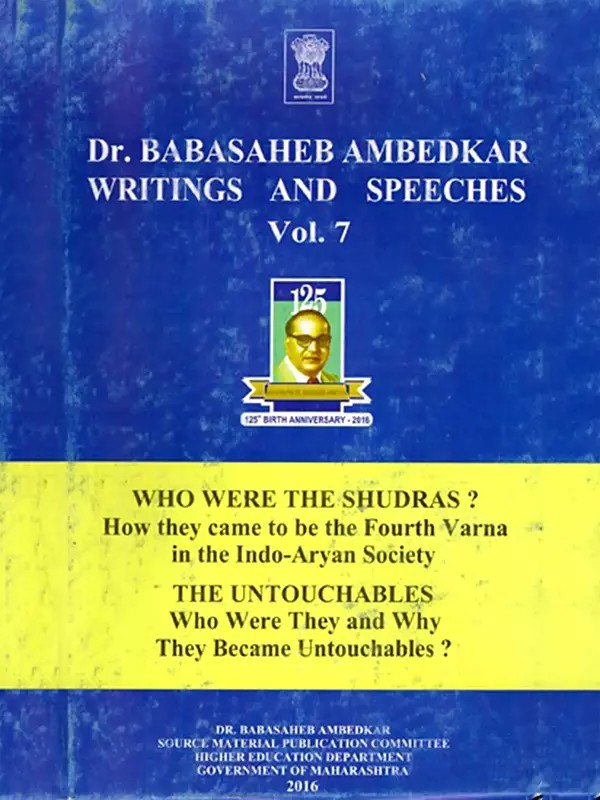
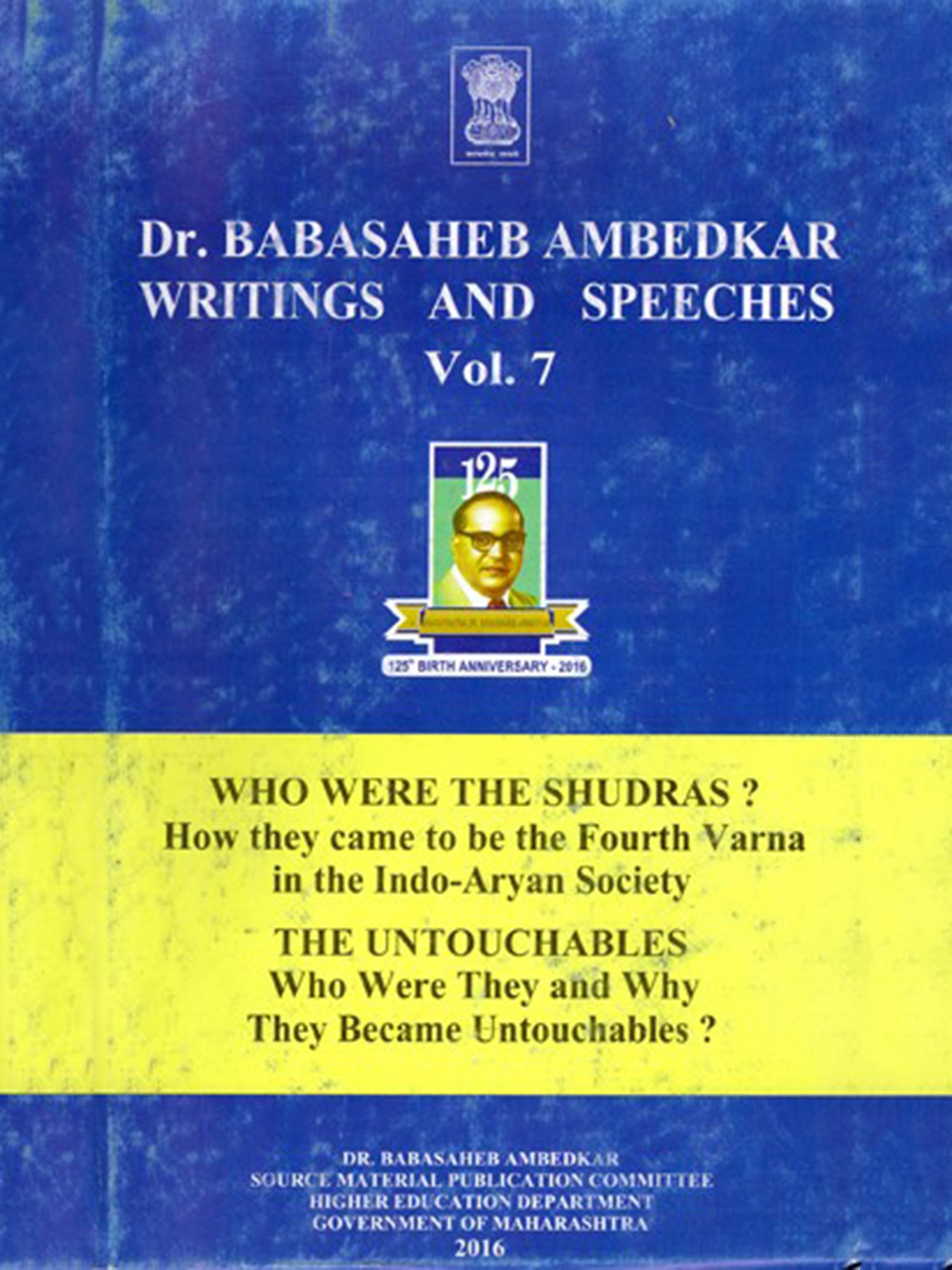
WHO WERE THE SHUDRAS?
How they came to be the Fourth Varna in the Indo-Aryan Society
THE UNTOUCHABLES
Who Were They and Why
They Became Untouchables ?
To idealize the real, which more often than not is full of inequities, is a very selfish thing to do. Only when a person finds a personal advantage in things as they are that he tries to idealize the real. To proceed to make such and ideal real is nothing short of criminal. It means perpetuating iniquity on the ground that whatever is once settled is settled for all times. Such a view is opposed to all morality. No society with a social conscience has ever accepted it. On the contrary, whatever progress in improving the terms of associated life between individuals and classes has been made in the course of history, is due entirely to the recognition of the ethical doctrine that what is wrongly settled is never settled and must be resettled.
In the present stage of the literature on the subject, a book on the Shudras cannot be regarded as a superfluity. Nor can it be said to deal with a trivial problem. The general proposition that the social organization of the Indo-Aryans was based on the theory of Chaturvarnya and that Chaturvarnya means division of society into four classes-Brahmins (priests), Kshatriyas (soldiers), Vaishyas (traders) and Shudras (menials) does not convey any idea of the real nature of the problem of the Shudras nor of its magnitude. Chaturvarnya would have been a very innocent principle if it meant no more than mere division of society into four classes. Unfortunately, more than this is involved in the theory of Chaturvarnya. Besides dividing society into four orders, the theory goes further and makes the principle of graded inequality the basis for determining the terms of associated life as between the four Varnas. Again, the system of graded inequality is not merely notional. It is legal and penal. Under the system of Chaturvarnya, the Shudra is not only placed at the bottom of the gradation but he is subjected to innumerable ignominies and disabilities so as to prevent him from rising above the condition fixed for him by law. Indeed until the fifth Varna of the Untouchables came into being, the Shudras were in the eyes of the Hindus the lowest of the low. This shows the nature of what might be called the problem of the Shudras. If people have no idea of the magnitude of the problem it is because they have not cared to know what the population of the Shudras is. Unfortunately, the census does not show their population separately. But there is no doubt that excluding the Untouchables the Shudras form about 75 to 80 per cent of the population of Hindus. A treatise which deals with so vast a population cannot be considered to be dealing with a trivial problem.